
❑ TEXTO: Leia o cartoon para responder à questão 01.

Taken from: http://www.fanpop.com/clubs/calvin-and-hobbes
Access: September, 2018.
01 – (MACKENZIE/SP-2019-VESTIBULAR-1º SEMESTRE)
According to the comic strip:
(A) Calvin is happy because his mother is preparing his favorite food.
(B) Calvin doesn’t know what tortellini is, but he says he hates it anyway.
(C) Calvin is looking up a tortellini recipe in a cookbook.
(D) His mother changes her mind and cooks something different.
(E) Calvin hates tortellini because it is gross.
(B) Calvin doesn’t know what tortellini is, but he says he hates it anyway.
(C) Calvin is looking up a tortellini recipe in a cookbook.
(D) His mother changes her mind and cooks something different.
(E) Calvin hates tortellini because it is gross.
👍 Gabarito B
TÓPICO - INFERÊNCIA, ELEMENTOS VERBAIS E NÃO-VERBAIS :
According to the comic strip:
De acordo com a história em quadrinhos:
(A) Calvin is happy because his mother is preparing his favorite food. – Calvin está feliz porque sua mãe está preparando sua comida favorita.(B) Calvin doesn’t know what tortellini is, but he says he hates it anyway. – Calvin não sabe o que é tortellini, mas diz que odeia mesmo assim.
(C) Calvin is looking up a tortellini recipe in a cookbook. – Calvin está procurando uma receita de tortellini em um livro de receitas.
(D) His mother changes her mind and cooks something different. – A mãe dele muda de ideia e cozinha algo diferente.
(E) Calvin hates tortellini because it is gross. – Calvin odeia tortellini porque é nojento.
❑ TRADUÇÃO DA TIRINHA:
➭ CALVIN: What's for dinner, mom? – O que tem para o jantar, mãe?
➭ MÃE: Tortellini. – Tortelline.
➭ CALVIN: Oh no, not tortellini!! I hate tortellini! Oh gross! Yecch! Tortellini!! – Oh não, não tortellini! Eu odeio tortellini! Ah, nojento! Ieca! Tortelini!!
➭ CALVIN: Nothing is more disgusting than tortellini. Can't we have something else? – Nada é mais nojento do que tortellini. Não podemos ter outra coisa?
➭ MÃE: No. – Não.
➭ CALVIN: Tortellini...Tortellini...t...o..r... – Tortellini...Tortellini...t...o..r...
❑ TEXTO: Leia o cartoon para responder às questões 02 a 05.

02 – (UNICENTRO-2019)
From the cartoon, we can assume that
(A) Calvin is a 6 year-old-boy who doesn’t have time to do his homework.
(B) Calvin is a misbehaving boy who doesn’t do his homework.
(C) Hobbes likes doing Calvin’s homework.
(D) Calvin did a lot of things this summer.
(E) Calvin is excited about doing homework.
👍 Gabarito B
TÓPICO - INFERÊNCIA, ELEMENTOS VERBAIS E NÃO-VERBAIS :
A partir do cartoon, podemos supor que
(A) Calvin is a 6 year-old-boy who doesn’t have time to do his homework. – Calvin é um menino de 6 anos que não tem tempo para fazer o dever de casa.
(B) Calvin is a misbehaving boy who doesn’t do his homework. – Calvin é um menino malcomportado que não faz o dever de casa.
(C) Hobbes likes doing Calvin’s homework. – Hobbes gosta de fazer o dever de casa de Calvin.
(D) Calvin did a lot of things this summer. – Calvin fez muitas coisas neste verão.
(E) Calvin is excited about doing homework. – Calvin está animado para fazer o dever de casa.
❑ TRADUÇÃO DA TIRINHA:
-1º quadrinho:
➭ CALVIN: I can't believe it! Homework already! I just got back to school! – Não acredito! Trabalhos de casa já! Acabei de voltar para a escola!
-2º quadrinho:
➭ CALVIN: I have to write a paragraph on what I did over the summer. A whole paragraph !!! – Tenho que escrever um parágrafo sobre o que fiz durante o verão. Um parágrafo inteiro !!!
-3º quadrinho:
➭ CALVIN: I'll never be able to write that much! It's not fair! – Nunca serei capaz de escrever tanto! Não é justo!
-4º quadrinho:
➭ CALVIN: How's coming? – Como vai?
➭ HOBBES: Not so good. What did you do besides watch TV? – Não tão bom. O que você fazia além de assistir TV?
03 – (UNICENTRO-2019)
Hobbes can’t succeed in writing the paragraph because
(A) Calvin did lots of activities during his vacation.
(B) He doesn’t know how to write.
(C) All Calvin did was watching TV this summer.
(D) He has to go to work.
(E) He doesn’t have enough time.
👍 Gabarito C
TÓPICO - INFERÊNCIA, ELEMENTOS VERBAIS E NÃO-VERBAIS :
Hobbes não consegue escrever o parágrafo porque
(A) Calvin did lots of activities during his vacation. – Calvin fez muitas atividades durante suas férias.
(B) He doesn’t know how to write. – Ele não sabe escrever.
(C) All Calvin did was watching TV this summer. – Tudo o que Calvin fez foi assistir TV neste verão.
(D) He has to go to work. – Ele tem que ir trabalhar.
(E) He doesn’t have enough time. – Ele não tem tempo suficiente.
04 – (UNICENTRO-2019)
How’s it coming? could be replaced in this context by
(A) How is it going?
(B) How far are you?
(C) Are you on the right pace?
(D) Could you go faster?
(E) So what?
👍 Gabarito A
TÓPICO - INFORMAÇÃO DENTRO DO TEXTO :
How’s it coming? could be replaced in this context by
Como está indo? poderia ser substituído neste contexto por
(A) How is it going? – Como vai?
(B) How far are you? – A que distância você está?
(C) Are you on the right pace? – Você está no ritmo certo?
(D) Could you go faster? – Você poderia ir mais rápido?
(E) So what? – E daí?
05 – (UNICENTRO-2019)
What can’t Calvin believe?
(A) Summer is over.
(B) He has to do homework.
(C) He will never write.
(D) He has no homework.
(E) Hobbies is not done writing the paragraph.
👍 Gabarito B
TÓPICO - INFERÊNCIA, ELEMENTOS VERBAIS E NÃO-VERBAIS :
Em que é que o Calvin não acredita?
(A) Summer is over. – O verão acabou.
(B) He has to do homework. – Ele tem que fazer lição de casa.
(C) He will never write. – Ele nunca escreverá.
(D) He has no homework. – Ele não tem lição de casa.
(E) Hobbies is not done writing the paragraph. – Hobbies não terminam de escrever o parágrafo.
❑ TEXTO: Leia o cartoon para responder à questão 06.

06 – QUESTION
👍 Gabarito B
TÓPICO - PHRASAL VERB :
❑ TRADUÇÃO DA TIRINHA:
-1º quadrinho:
➭ CALVIN: This water is freezing! I'm going to go into shock and drown, I just konw it. – Esta água está gelada! Vou entrar em choque e me afogar, eu simplesmente sei disso.
-2º quadrinho:
➭ CALVIN: I bet the lifeguard is involved in some insurance scam and she's going to let us all drown like rats! Oh no! Oh no! – Aposto que a salva-vidas está envolvida em algum golpe de seguro e vai deixar todos nós nos afogarmos como ratos! Oh não! Oh não!
-3º quadrinho:
➭ PROFESSORA (A SALVA-VIDAS): Ok, first were going to learn the "deadman's float". – Ok, primeiro vamos aprender a "boia do homem morto".
-4º quadrinho:
➭ CALVIN: Mom! Helpp! Helpp! – Mãe! Socorro! Socorro!
➭ PROFESSORA: What a put up with to pay my college... – O que é que tenho que tolerar para pagar a minha faculdade...
❑ PUT UP WITH: SUPORTAR, TOLERAR.

https://dictionary.cambridge.org/dictionary/
english/put-up-with?q=PUT+UP+WITH
❑ TEXTO: Read the text (Calvin & Hobbes) and answer the question 07 to 11.
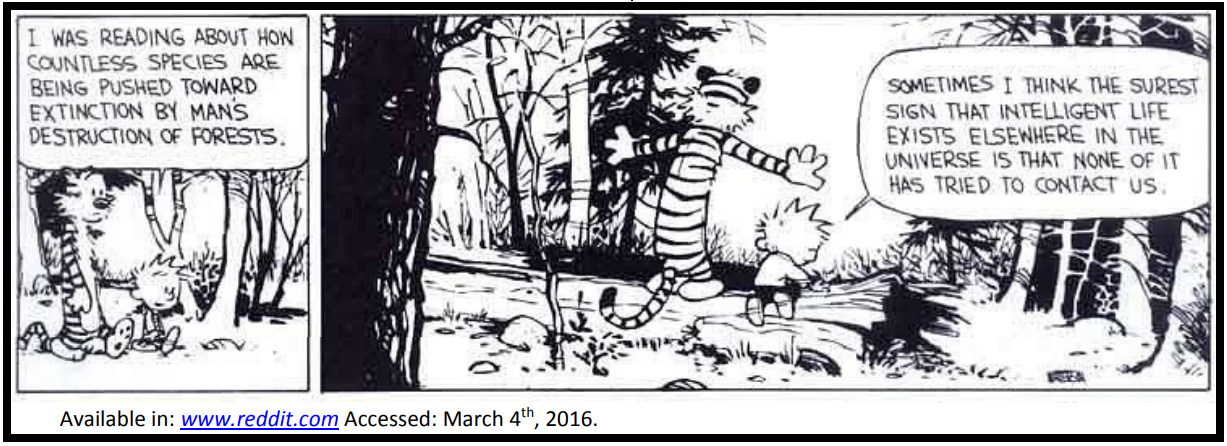
07 – (PM-DMC-RS-2016-PROFESSOR)
Read the sentences about the text above:
I. The text is a comic strip.
II. Calvin and Hobbes don’t like human activities that
led to deforestation.
III. They prefer to have dangerous and thrilling
adventures inside this environment destroyed.
IV. Calvin’s tone in the final can best be described as
hopeless.
(A) Only II and IV are correct.
(B) Only I and II are correct.
(C) Only I and III are correct.
(D) Only II and III are correct.
(E) Only III is correct.
👍 Gabarito B
TÓPICO - INFERÊNCIA, ELEMENTOS VERBAIS E NÃO-VERBAIS :
I. The text is a comic strip. – O texto é uma história em quadrinhos.
II. Calvin and Hobbes don’t like human activities that led to deforestation. – Calvin e Hobbes não gostam de atividades humanas que levaram ao desmatamento.
III. They prefer to have dangerous and thrilling adventures inside this environment destroyed. – Eles preferem que aventuras perigosas e emocionantes dentro deste ambiente sejam destruídas.
IV. Calvin’s tone in the final can best be described as hopeless. – O tom de Calvin na final pode ser melhor descrito como desesperador.
❑ TRADUÇÃO DA TIRINHA:
-1º quadrinho:
➭ HOBBES: I was reading about how countless species are being pushed toward extinction by man's destruction of forests. – Eu estava lendo sobre como inúmeras espécies estão sendo levadas à extinção pela destruição das florestas pelo homem.
-2º quadrinho:
➭ CALVIN: Sometimes i think the surest sign that intelligent life exists elsewhere in the universe is that none of it has tried to contact us. – Por vezes, penso que o sinal mais seguro de que existe vida inteligente noutras partes do universo é o fato de nenhuma delas ter tentado contactar-nos.
08 – (PM-DMC-RS-2016-PROFESSOR)
According to the text, the following statements are
false EXCEPT which one?
(A) There are many species of endangered animals.
(B) Calvin stressed the need to protect the natural
environment and the forest heritage.
(C) Calvin told beings from other universe tried contact
with him.
(D) Hobbes agrees with Calvin that Earth is the surest
place in all universe.
(E) Animals that live in the wild have better lives than
animals kept in cages.
👍 Gabarito E
TÓPICO - INFERÊNCIA, ELEMENTOS VERBAIS E NÃO-VERBAIS :
De acordo com o texto, as seguintes afirmações são falsas, EXCETO qual?
(A) There are many species of endangered animals. – Existem muitas espécies de animais ameaçados de extinção.
(B) Calvin stressed the need to protect the natural environment and the forest heritage. – Calvin enfatizou a necessidade de proteger o ambiente natural e o patrimônio florestal.
(C) Calvin told beings from other universe tried contact with him. – Calvin disse que seres de outro universo tentaram contato com ele.
(D) Hobbes agrees with Calvin that Earth is the surest place in all universe. – Hobbes concorda com Calvin que a Terra é o lugar mais seguro em todo o universo.
(E) Animals that live in the wild have better lives than animals kept in cages. – Os animais que vivem na natureza têm vidas melhores do que os animais mantidos em gaiolas.
09 – (PM-DMC-RS-2016-PROFESSOR)
Which is the best synonym for countless?
(A) bound
(B) restricted
(C) limited
(D) marvellous
(E) myriad
👍 Gabarito E
TÓPICO - VOCABULARY :
Which is the best synonym for countless?
Qual é o melhor sinônimo para incontáveis?
(A) bound – vinculado
(B) restricted – restrito
(C) limited – limitado
(D) marvellous – maravilhoso
(E) myriad – uma miríade
10 – (PM-DMC-RS-2016-PROFESSOR)
Which sentence from the text shows an example of
Passive Voice?
(A) I was reading about…
(B) I think the surest sign…
(C) …intelligent life exists elsewhere…
(D) …how countless species are being pushed toward…
(E) …none of it has tired to contact us.
👍 Gabarito D
TÓPICO - PASSIVE VOICE (BE + Particípio Passado) :
Qual frase do texto mostra um exemplo de Voz Passiva?
(A) I was reading about… (Sem o Particípio Passado)
(B) I think the surest sign…(Sem o BE)
(C) …intelligent life exists elsewhere… (Sem o BE)
(D) …how countless species are being pushed toward… (PASSIVE VOICE)
(E) …none of it has tired to contact us. (Sem o BE)
11 – (PM-DMC-RS-2016-PROFESSOR)
“…none of it has tired to contact us.”
Us is:
(A) a possessive pronoun.
(B) a possessive adjective.
(C) an object pronoun.
(D) a reference to a country.
(E) a noun.
👍 Gabarito C
TÓPICO - GRAMMAR :

https://www.woodwardenglish.com/
lesson/object-pronouns-in-english/
❑ TEXTO: Leia a tirinha para responder à questão 12.

12 – (PUC-SP-2017)
A tirinha acima mostra que:
(A) Calvin sabe contornar a situação criada pelo castigo.
(B) a mãe de Calvin está certa ao reclamar com o pai dele que o castigo foi exagerado.
(C) Calvin decide não comer assim que prova a comida.
(D) o pai de Calvin não tem certeza de que o castigo aplicado seja a maneira mais eficiente de educá-lo.
👍 Gabarito A
TÓPICO - INFERÊNCIA, ELEMENTOS VERBAIS E NÃO-VERBAIS :
❑ TRADUÇÃO DA TIRINHA:
-1º quadrinho:
➭ CALVIN: This smells like bat barf! – Isso cheira a vômito de morcego!
➭ PAI: That does it, young man! You are excused to your room. – Já chega, meu jovem! Pode ir para o seu quarto.
-2º quadrinho:
➭ MÃE: Don't you think, that's a little harsh, dear? He'll get hungry. – Você não acha que isso é um pouco duro, querido? Ele vai ficar com fome.
-3º quadrinho:
➭ PAI: Calvin has got to learn some manners! He won't starve to death. – Calvin precisa aprender boas maneiras! Ele não morrerá de fome.
-4º quadrinho:
➭ CALVIN: ... and extra pepperoni. – ... e calabresa extra.
IDEIA CONTEXTUAL: Ao reclamar que a comida posta à mesa de sua casa tem cheiro de vômito de morcego, Calvin recebe severa reprimenda de seu pai, e é expulso da mesa. Calvin então contorna a situação ligando para um restaurante e solicitando como complemento de seu pedido uma calabresa extra.
❑ TEXTO: A tira a seguir é referência para as questões 13 e 14.

13 – (UFPR-2015-VESTIBULAR)
Consider the question Calvin asks:
“How can you be creative when someone’s breathing down your neck?”
The purpose of it is:
(A) to complain about the result of a test.
(B) to complain about writing a text on teaching.
(C) to question why someone has to learn how to write.
(D) to question how someone can be creative and meet the requirements of a writing task.
(E) to question why someone has to be standing at the back of another person, by his or her neck.
👍 Gabarito D
TÓPICO - EXPRESSÃO IDIOMÁTICA :
- 'when someone’s breathing down your neck' = QUANDO ALGUÉM ESTÁ NA SUA COLA (quando alguém está te observando constantemente. (Merriam-webster Dictionary)
- Uso conotativo e com sentido irônico.
❑ TRADUÇÃO DA TIRINHA:
-1º quadrinho:
➭ CALVIN: If you ask me, these assignments don't teach you how to write, they teach you how to hate to write. – Se você me perguntar, essas tarefas não ensinam como escrever, elas te ensinam como odiar a escrever.
-2º quadrinho:
➭ CALVIN: Deadlines, rules how to do it, grades ... how can you be creative when someone's breathing down your neck? – Prazos, regras de como fazer, notas... como você pode ser criativo quando alguém está na sua cola?
-3º quadrinho:
➭ HOBBES: I guess you should try not to think about the end result too much and just have fun with the process of creating. – Acho que você deveria tentar não pensar muito no resultado final e apenas se divertir com o processo de criação.
-4º quadrinho:
➭ CALVIN: Every time I do that, I end up in the school psychologist's office. – Sempre que faço isso, acabo no gabinete do psicólogo da escola.
14 – (UFPR-2015-VESTIBULAR)
Hobbes suggests that Calvin should not think about the result of a writing task but rather have fun with the process of creating.
Why is this suggestion NOT a profitable one?
(A) Because Calvin is doing his final exams.
(B) Because Calvin cannot be creative while writing.
(C) Because Calvin feels he will fail his writing course.
(D) Because Hobbes does not know how much effort the process of writing requires.
(E) Because Calvin was sent to the psychologist at school every time he had fun with writing.
👍 Gabarito E
TÓPICO - INFERÊNCIA, ELEMENTOS VERBAIS E NÃO-VERBAIS :
Hobbes sugere que Calvin não deveria pensar no resultado de uma tarefa de escrita, mas sim se divertir com o processo de criação.
Por que esta sugestão NÃO é lucrativa?
(A) Because Calvin is doing his final exams. – Porque Calvin está fazendo os exames finais.
(B) Because Calvin cannot be creative while writing. – Porque Calvin não consegue ser criativo enquanto escreve.
(C) Because Calvin feels he will fail his writing course. – Porque Calvin sente que será reprovado no curso de redação.
(D) Because Hobbes does not know how much effort the process of writing requires. – Porque Hobbes não sabe quanto esforço exige o processo de escrita.
(E) Because Calvin was sent to the psychologist at school every time he had fun with writing. – Porque Calvin era encaminhado ao psicólogo da escola toda vez que se divertia escrevendo.
❑ TEXTO: Answer questions 15-17 with information from text.
Fill in the gaps with the suitable pronouns

15 – (PUC/RS-2014-VESTIBULAR INVERNO)
(A) my – she – her – his
(B) my – it – our – its
(C) his – it – his – her
(D) his – he – his – its
(E) its – he – our – our
(B) my – it – our – its
(C) his – it – his – her
(D) his – he – his – its
(E) its – he – our – our
👍 Gabarito B
TÓPICO - GRAMMAR :
❑ 1º QUADRINHO:
➭ HOBBES: Still making snow art? – Ainda fazendo arte de neve?
➭ CALVIN: Yep! – Sim!
❑ 2º QUADRINHO:
➭ HOBBES: Yesterday your sculpture melted. – Ontem sua escultura derreteu.
➭ CALVIN: This time, I'm taking advantage of _____ medium's impermanence. Desta vez, estou aproveitando a impermanência do meu meio.
❑ 3º QUADRINHO:
➭ CALVIN: This sculpture is about transience. As this figure melts, ___ invites the viewer to contemplate the evanescence of life. This piece speaks to the horror of our own mortality! – Esta escultura é sobre transitoriedade. Enquanto esta figura derrete, convida o espectador a contemplar a evanescência da vida. Esta peça fala do horror da nossa própria mortalidade!
❑ 4º QUADRINHO:
➭ DESCONHECIDO: Hey stupid! It's too warm to build a snowman! What a dope! Ha...Ha...Ha...Ha...! – Ei, estúpido! Está muito quente para construir um boneco de neve! Que droga! Ha ... Ha ... Ha ... Ha ...!
➭ HOBBES: A philistine on the sidewalk. – Um filisteu na calçada.➭ CALVIN: Genius is never understood in his own time! – Gênio nunca é entendido em seu próprio tempo!
16 – (PUC/RS-2014-VESTIBULAR INVERNO)
I. Calvin esculpe bonecos de neve com o propósito de vê-los derreter.
II. Calvin considera a escultura de neve uma representação da brevidade da vida.
III. Calvin e Haroldo discordam sobre o conceito de arte.
IV. há uma terceira voz que zomba de Calvin e seu boneco de neve.
As afirmativas corretas são, apenas,
(A) I e II.
(B) I e III.
(C) II e III.
(D) II e IV.
(E) III e IV.
(B) I e III.
(C) II e III.
(D) II e IV.
(E) III e IV.
👍 Gabarito D
TÓPICO - INFERÊNCIA, ELEMENTOS VERBAIS E NÃO-VERBAIS :
The word “AS” on the third frame conveys the same meaning of
17 – (PUC/RS-2014-VESTIBULAR INVERNO)
(A) like.
(B) although.
(C) so.
(D) while.
(E) when.
(B) although.
(C) so.
(D) while.
(E) when.
👍 Gabarito D
TÓPICO – GRAMMAR – "AS" as a TIME CONJUNCTION :
❑ SENTENÇA CONTEXTUAL:
➭ “As this figure melts, it invites the viewer to contemplate the evanescence of life.”
➭ ENQUANTO esta figura se derrete, ela convida o espectador a contemplar a evanescência da vida.
❑ Na sentença do texto acima, "AS" funciona como uma "time conjunction", com significado de WHILE’ e apresenta uma relação de simultaneidade entre as ações retratadas nas orações. ("AS" TEMPORAL)
❑ TIME CLAUSE: É um tipo oração iniciada por uma conjunção de tempo "TIME CONJUNCTION" (when, after, before, until, while, since, while, once, as soon as, as).
❑ Usamos a conjunção "AS" iniciando uma "time clause" quando um evento acontece ENQUANTO outro está em andamento, ou seja, neste contexto, "AS" apresenta uma relação de simultaneidade entre as ações apresentadas nas orações. Por exemplo: They arrived as we were leaving. ("AS" funciona como uma "time conjunction" com significado de ‘while’).


❑ TEXTO: Questions 18 to 19 are related to the comic strip below.

18 – (UFRGS-2014-VESTIBULAR)
Select the correct alternative to fill the gaps in panels 1 and 2, respectively.
(A) extremely – Unfortunately
(B) hopelessly – Fortunately
(C) finally – Incredibly
(D) irremediably – Unhappily
(E) slightly – surprisingly
👍 Gabarito B
TÓPICO - INFORMAÇÃO DENTRO DO TEXTO :
19 – (UFRGS-2014-VESTIBULAR)
Consider the sentence below and the suggestions to complete it.
The best translations into Portuguese for
1 - “be prepared” (panel 2) is estamos preparados.
2 - with this full backpack (panel 3) is com esta mochila cheia.
3 - Just so long as we don’t get hungry (panel 4) is Só enquanto não sentirmos fome.
Which of the suggestions above can be considered correct according to the text?
(A) Only 1.
(B) Only 2.
(C) Only 3.
(D) Only 2 and 3.
(E) 1, 2 and 3.
👍 Gabarito D
TÓPICO - TRADUÇÃO :
❑ TEXTO: Questions 20 to 21 are related to the comic strip below.

Calvin and Hobbes by Bill Watterson
December 27, 2014
20 – (ESPM/SP-2015/1)
In the sentence “When we came in, I'd have to take all that stuff off” (second frame of the comic strip), Calvin is talking about a hypothetical situation.
If he were talking about a real possibility, he would have said:
(A) If we came in, I'd have to take all that stuff off.
(B) When we came in, I should have to take all that stuff off.
(C) When we come in, I'll have to take all that stuff off.
(D) If we come in, I'd have to take all that stuff off.
(E) After we came in, I'd have to take all that stuff off.
👍 Gabarito C
TÓPICO - INFORMAÇÃO DENTRO DO TEXTO :
21 – (ESPM/SP-2015/1)
According to the strip:
(A) Calvin is willing to go outside and play.
(B) Hobbes thinks that staying inside is a clever decision.
(C) Hobbes is going to get Calvin a glass of water.
(D) Calvin is going to play outside after he sees a good TV show.
(E) Hobbes compares Calvin to a plant.
👍 Gabarito E
TÓPICO - INFERÊNCIA, ELEMENTOS VERBAIS E NÃO-VERBAIS :
❑ TEXTO: Questions 22 to 26 are related to the comic strip below.

(Bill Watterson’s Calvin and Hobbes, http://home.loloyd.com/ebooks/
Calvin%20and%20Hobbes/9312/ch931201.gif
Acesso em: 04.12.2013)
22 – (FATEC-2014/2)
De acordo com a fala de Calvin no primeiro quadro da tirinha
(A) o menino se sente feliz com a recomendação da mãe dele.
(B) o menino não compreende como fazer o trabalho sem a ajuda da mãe dele.
(C) o menino foi autorizado a ficar acordado até mais tarde para terminar o trabalho.
(D) a mãe do menino se recusa a ajudá-lo com o trabalho.
(E) a mãe do menino diz que ele precisa aprender a economizar papel.
👍 Gabarito C
TÓPICO - INFERÊNCIA, ELEMENTOS VERBAIS E NÃO-VERBAIS :
23 – (FATEC-2014/2)
No segundo quadro da tirinha, Hobbes
(A) parabeniza Calvin pelo bom desempenho.
(B) apoia Calvin na disputa entre o menino e a mãe dele.
(C) lamenta que Calvin tenha de terminar logo o trabalho.
(D) repreende Calvin por seu descaso com o uso de papel.
(E) relembra Calvin a respeito de algo que a mãe do menino dissera.
👍 Gabarito E
TÓPICO - INFERÊNCIA, ELEMENTOS VERBAIS E NÃO-VERBAIS :
24 – (FATEC-2014/2)
No terceiro quadro da tirinha, Calvin afirma que não conseguirá a nota “A” que ele julga merecer pois
(A) Hobbes está atrapalhando o trabalho dele.
(B) a professora dele não explicou o que ele tinha que fazer.
(C) a professora dele não deu tempo bastante para que ele terminasse o trabalho.
(D) a mãe dele o levou a fazer um trabalho descuidado e às pressas.
(E) a mãe dele e a professora deram informações divergentes sobre o trabalho.
👍 Gabarito D
TÓPICO - INFERÊNCIA, ELEMENTOS VERBAIS E NÃO-VERBAIS :
25 – (FATEC-2014/2)
No último quadro da tirinha, os quinze minutos que Hobbes menciona dizem respeito ao tempo que Calvin
(A) passou reclamando.
(B) gastou no trabalho até então.
(C) levaria para terminar o trabalho.
(D) levaria para apresentar o trabalho.
(E) demorou para entender o trabalho.
👍 Gabarito A
TÓPICO - INFERÊNCIA, ELEMENTOS VERBAIS E NÃO-VERBAIS :
26 – (FATEC-2014)
A contração won’t presente na fala de Calvin “I won’t get the ‘A’ I deserve!”
é composta pelos termos
(A) will not.
(B) want to.
(C) want not.
(D) would not.
(E) wanted not.
👍 Gabarito A
TÓPICO - CONTRAÇÃO - WON'T (WILL+NOT) :
❑ TEXTO: for the questions from 31 to 35.
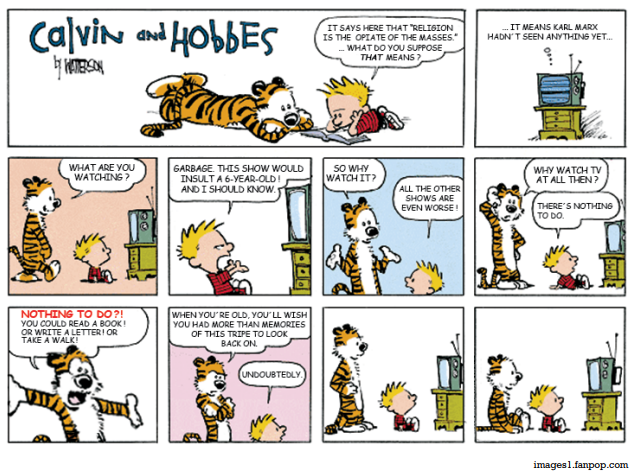
images1.fanpop.com
31 – (UERJ-2015/2016-VESTIBULAR-1º EXAME)
Besides being funny, comics often expresses criticism. The comic strip criticizes men’s incapacity to take the following action:
(A) fight what baffles them
(B) confront what fools them
(C) resist what alienates them
(D) avoid what confuses them
(B) confront what fools them
(C) resist what alienates them
(D) avoid what confuses them
👍 Gabarito C
32 – (UERJ-2015/2016-VESTIBULAR-1º EXAME)
(A) 5
(B) 6
(C) 7
(D) 8
(B) 6
(C) 7
(D) 8
👍 Gabarito C
TÓPICO - INFERÊNCIA, ELEMENTOS VERBAIS E NÃO-VERBAIS :
33 – (UERJ-2015/2016-VESTIBULAR-1º EXAME)
The second that fulfils the following cohesive function:
(A) showing emphasis in speech
(B) refering back to the quotation
(C) pointing to the book in the picture
(D) linking main and subordinate clauses
(B) refering back to the quotation
(C) pointing to the book in the picture
(D) linking main and subordinate clauses
👍 Gabarito B
TÓPICO - INFORMAÇÃO DENTRO DO TEXTO :
34 – (UERJ-2015/2016-VESTIBULAR-1º EXAME)
Modal verbs can be used to refer to a speaker’s attitude.
The modal should indicates that Calvin believes his knowledge of the bad quality of the TV show would be characterized as:
(A) desirable
(B) probable
(C) surprising
(D) mandatory
(B) probable
(C) surprising
(D) mandatory
👍 Gabarito A
TÓPICO - INFORMAÇÃO DENTRO DO TEXTO :
35 – (UERJ-2015/2016-VESTIBULAR-1º EXAME)
By establishing links between different parts of a text, one might guess the meaning of an unknown word.
Based on Calvin’s evaluation of the show he is watching, the meaning of the word tripe, in panel 8, is:
(A) fun
(B) trash
(C) pastime
(D) program
(B) trash
(C) pastime
(D) program
👍 Gabarito B
TÓPICO - INFERÊNCIA, ELEMENTOS VERBAIS E NÃO-VERBAIS :
❑ TEXTO: Questions 36 and 37 refer to the comic strip below:

Calvin and Hobbes by Bill Watterson. Available at: https://www.gocomics.com/comics/lists/1722981/35-years-of-calvin-and-hobbes
36 – (UNITAU-SP-2022-VESTIBULAR INVERNO-MEDICINA)
What sentence best describes Calvin’s feelings about spending his time on math homework?
a) Let’s not and say we did.
b) It’s a free country.
c) I got rights!
d) I already spent 10 whole minutes on it!
e) So I was off a little bit.
👍 Gabarito D
TÓPICO - INFERÊNCIA, ELEMENTOS VERBAIS E NÃO-VERBAIS :
Qual frase melhor descreve os sentimentos de Calvino em relação a gastar seu tempo com trabalhos de matemática?
a) Let’s not and say we did..– Não vamos dizer que sim.
b) It’s a free country..– É um país livre.
c) I got rights!.– Eu tenho direitos!
d) I already spent 10 whole minutes on it!.– Já gastei 10 minutos inteiros nisso!
e) So I was off a little bit.– Então eu me afastei um pouco.
37 – (UNITAU-SP-2022-VESTIBULAR INVERNO-MEDICINA)
The use of verbal tenses in “I already spent 10 whole minutes on it” and “I’ve got my rights” are correctly explained by:
a) The past simple is used in the first sentence because it indicates an action done at a specific time in the past and the present perfect is used in the second because it indicates something that has been true since a time in the past.
b) The past simple tense is used in the first and the last sentences because both indicate actions that were done at a specific time in the past.
c) The past perfect tense is used in the first and the last sentences because they both indicate actions that have been happening since a moment in the past.
d) The past simple is used in the first sentence because it indicates an action done at a specific time in the past and the past perfect is used in the second because it indicates something that has been true since a time in the past.
e) The past perfect is used in the first sentence because it indicates an action done at a specific time in the past and the present perfect is used in the second because it indicates something that has been true since a time in the past.
👍 Gabarito A
TÓPICO - SIMPLE PAST & PRESENT PERFECT :
O passado simples é usado na primeira sentença porque indica uma ação realizada em um momento específico no passado e o presente perfeito é usado na segunda porque indica algo que foi verdadeiro desde um momento no passado não especificado.
teste
Comentários
Postar um comentário